
- June 4, 2026
- Posted by: Hussain Sidhique
- Category: Blog
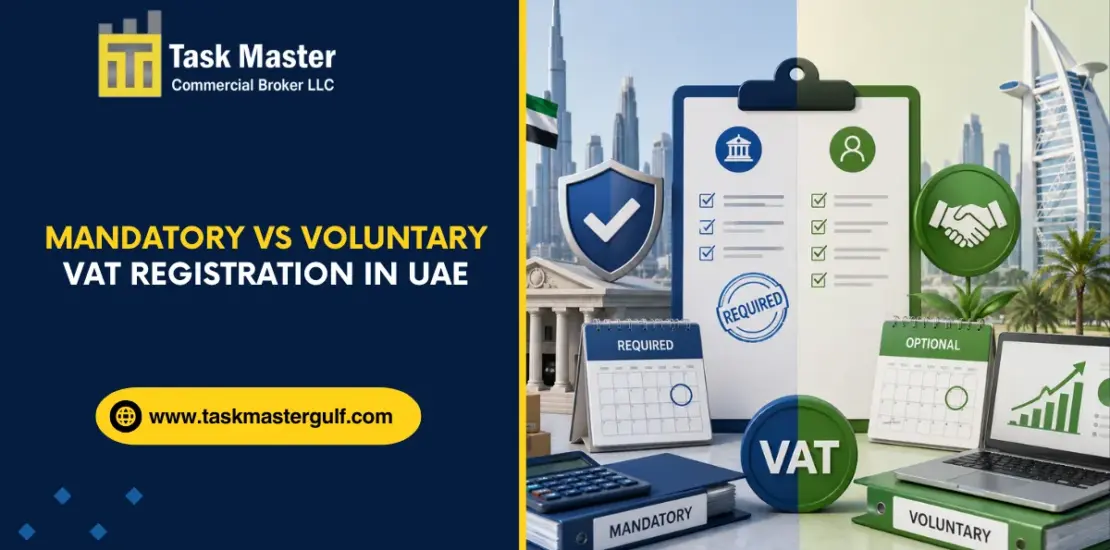
In the UAE, mandatory VAT registration is a legal need once your taxable supplies exceed AED 375,000 in a rolling 12-month duration or are expected to in the next 30 days. Voluntary VAT registration is an optional choice for companies with turnover or taxable expenditures between AED 187,500 and AED 375,000.
Handling the tax landscape in the UAE is a crucial milestone for any expanding business. Ever since the UAE presented VAT at a standard rate of 5% in 2018, comprehending financial obligations has changed from a best practice to a crucial legal need. For businesspeople, startups, and established companies alike, one of the most pressing questions is deciding between mandatory VAT registration UAE and Voluntary VAT registration. Making the inappropriate move or missing a deadline can lead to steep financial fines.
Table of Contents
What is VAT in the UAE?
Value Added Tax is an indirect tax applied to the consumption or usage of goods and services. It is collected for every phase of the supply chain on behalf of the Federal Tax Authority. While the standard rate is a relatively low 5%, handling it demands meticulous record-keeping, accurate calculations, and prompt filings.
Understanding Mandatory VAT Registration in UAE
If your company is resident in the United Arab Emirates and its taxable supplies and imports surpass AED 375,000 more than the previous 12 months, or are lawfully expected to exceed that amount in the next 30 days, registration is compulsory.
The standard threshold doesn’t apply to foreign companies. If a non-resident company makes any taxable supplies within the United Arab Emirates and no other person complies with accounting for the tax, they have to register for VAT from their very first transactions, no matter the amount.
Understanding Voluntary VAT Registration in UAE
If your company turnover or your taxable costs exceed AED 187,500 but haven’t yet touched the AED 375,000 mark, you have the choice to register voluntarily.
Why would a company register for tax when it does not have to? The answer depends on import tax recovery. Startups with high starting formation costs pay a remarkable amount of VAT to their suppliers. By registering voluntarily, they can reclaim that VAT from the government, promoting their short-term cash flow.
Mandatory vs Voluntary VAT Registration – The Core Differences

The main differentiator between mandatory and voluntary registration is your business’s taxable turnover threshold. The FTA tracks this on a 12-month rolling basis, meaning it isn’t tied to a calendar year or a particular financial year. You have to look back at the previous 12 months regularly, or look forward to the next 30 days.
| Feature | Mandatory VAT Registration | Voluntary VAT Registration UAE |
| Threshold Limit | Exceeds AED 375,000 | Exceeds AED 187,500 but below AED 375,000 |
| Timeframe | Past 12 months or next 30 days | Past 12 months or next 30 days |
| Legal Obligation | Compulsory by law | Optional, business choice |
| Application Deadline | Within 30 days of hitting the threshold | Anytime after crossing the minimum limit. |
| Late Fine | AED 10,000 for delayed application | No penalty (since it is optional) |
How to Calculate Your Taxable Turnover
A number of company owners confuse total profit with taxable turnover. To decide if you have crossed a threshold, your calculation should comprise –
1. Standard-Rated Supplies – All goods and services sold within the UAE are subject to 5% VAT.
2. Zero-Rated Supplies – Export of goods and services outside the GCC, global transport, and some healthcare or educational services.
3. Imported Goods and Services – Supplies brought into the UAE that would be subject to VAT if bought domestically.
Exempt supplies. Some financial services, residential real estate sales or leases after the initial supply, bare land, and local visitors’ transport are thoroughly free from VAT. Don’t include these numbers when calculating your registration thresholds.
Understanding the Tax Registration Number (TRN)

Once your application is examined and sanctioned by the FTA, your business will be given a remarkable 15-digit identifier, renowned as the Tax Registration Number UAE.
Getting your TRN registration UAE officially turns your business into a taxable person in the eyes of the law. This number should be transparently displayed on all your business documents, particularly on your sales tax invoices. Your customers will demand this TRN to examine your business’s legitimacy and claim their own input tax deductions.
Step-by-Step VAT Registration Process
The whole registration structure is digitized through the FTA’s single sign-on platform, EmaraTax.
1. Account Setup – Make an account on the EmaraTax outlet through the official FTA website, check your email, and set up your taxable person profile.
2. Document Preparation – Collect your legal UAE trade license, Memorandum of Association, passport, and Emirates ID copies of owners/managers, bank account details, and an itemized financial record proving your 12-month turnover.
3. Form Submission – Fill out the online VAT registration form, inputting desired sales, business activities, and customs code information. Upload all necessary documents and double-check for absolute precision.
4. FTA Reviews & Approval – The FTA reviews your files. If details are missing, they will send a clarification approach. Once pleased, they sanction the profile and give you a VAT certificate containing your TRN.
To examine typical processing times and thorough document checklists, you can cross-verify your details on ClearTax UAE VAT rules.
2026 UAE VAT Law Updates – Simplified Rules
Staying adherent means staying updated with current legal modifications. Following the roll-out of Federal Decree-Law No. 16 of 2025, primary simplifying updates went into effect on January 1, 2026 –
1. No More Self-Invoicing – Companies no longer have to give manual self-invoices under the Reverse Charge Mechanism for imported services. Common commercial agreements and vendor invoices are now appropriate paperwork.
2. 5-year Refund Limitation – The FTA has formalized a stringent five-year window to claim excess recoverable VAT following your account reconciliation. Unclaimed historical refunds older than 5 years will expire, pushing companies to be extremely forceful with their cash-flow audits.
3. Anti-Evasion Screening – The FTA now possesses explicit powers to deny input tax deductions if a transaction is found to be connected to tax evasion schemes, focusing on stringent vendor due diligence.
Post-Registration Obligations – Returns and Penalties
Getting your TRN is only the start. Post-registration, your corporation is bound by stringent periodic adherence rules.
VAT Return Filing –
Registered companies should file a routine online tax return through EmaraTax, typically on a quarterly or monthly basis, based on their annual turnover. The VAT filing UAE deadline is always the 28th day of the month following the end of your tax duration. For example, if your tax quarter ends on March 31, your return should be presented, and payment should clear the FTA’s bank account by April 28.
VAT Penalties in the UAE –
The Federal Tax Authority enforces stringent adherence, and late actions hold painful financial hits –
1. Late Registration – If you cross the AED 375,000 threshold and fail to present your registration form within 30 days, a fixed late cost of AED 10,000 is applied.
2. Late Return Filing – Missing your filing deadline incurs an instant AED 1,000 penalty for the first offense, which doubles to AED 2,000 if repeated within 24 months.
3. Late Tax Payment – Delaying tax payments triggers a direct late-payment fine of 2%, plus an extra 4% monthly interest charge on the unpaid tax balance until it is cleared.
Why You Need Professional VAT Consultancy Services
While the EmaraTax portal is user-friendly, establishing accounting systems, examining vendor TRNs, calculating partial exemptions, and precisely filing out boxes on a tax return can rapidly become daunting for business owners.
Collaborating with expert UAE VAT compliance services makes sure your books are clean, your invoices are lawfully bulletproof, and your filings are mistake-free. This secures your company from costly audits and unwanted penalties.
Simplify Your Taxes with Taskmaster Gulf
Handling corporate tax and VAT demands must not pull you away from growing your company. Taskmaster Gulf delivers top-tier, trusted VAT registration service in UAE, customized explicitly to your remarkable business model.
From researching whether you are eligible for voluntary registration to managing your VAT return filing in the UAE, our experienced professionals make sure your functions stay completely aligned with the current 2026 legal updates. Lean on our leading VAT consultancy services in Dubai, UAE to protect your cash flow, protect your input tax recovery, and remove tax-related stress.
Also Read: Common VAT Filing Mistakes in UAE: How Businesses Can Avoid FTA Penalties
Frequently Asked Questions (FAQs)
What are the threshold limits for mandatory and voluntary VAT registration in the UAE?
VAT registration is mandatory if your business’s taxable turnover exceeds AED 375,000 over the past 12 months or the next 30 days. Registration is voluntary if your taxable turnover or taxable costs exceed AED 187,500 but remain below the compulsory limit.
Can a startup with no sales register for VAT voluntarily?
Yes. If your company hasn’t generated sales yet but your taxable costs have crossed the AED 187,500 mark more than the previous 12 months, you are thoroughly eligible to make an application for voluntary VAT registration.
What is the deadline to register for VAT once I hit the mandatory threshold?
You should present your VAT registration application to the Federal Tax Authority within 30 days of crossing the compulsory threshold limit of AED 375,000.
What is the financial penalty for late VAT registration?
If your company fails to make an application for mandatory VAT registration within the needed 3-day window, the FTA will apply a certain management penalty of AED 10,000 for late registration.
Why should a business register for VAT voluntarily?
The primary advantage is input tax recovery. By registering voluntarily, a company can lawfully reclaim the 5% VAT it pays on business-related costs and startup expenses from the government, which directly enhances short-term cash flow.


