
- June 1, 2026
- Posted by: Hussain Sidhique
- Category: Blog
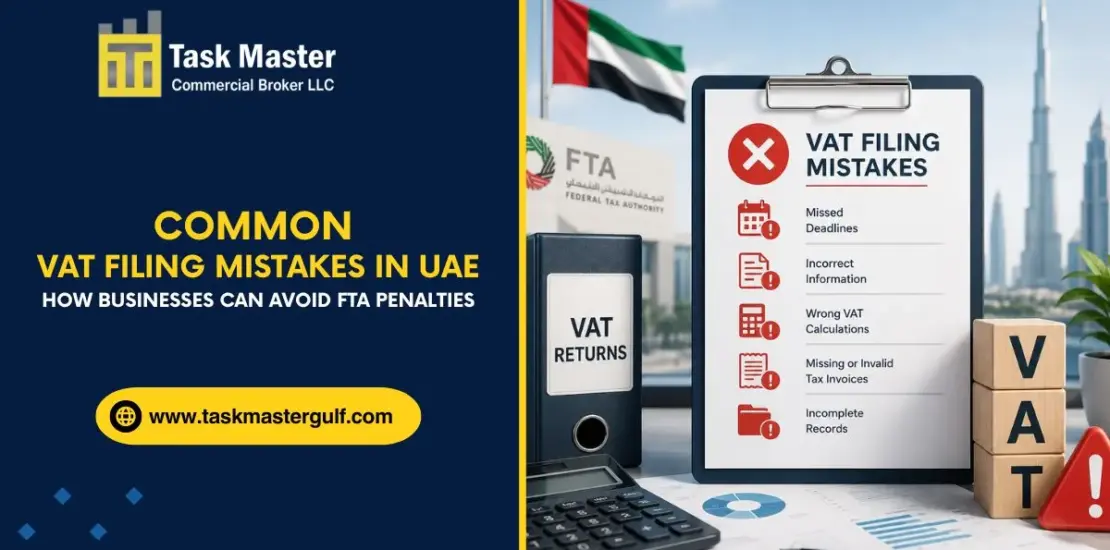
VAT filing mistakes in UAE can result in major financial problems, including hefty fines from the FTA. The most common VAT errors made by businesses are late registration, incorrect return submission, and poor record-keeping. To avoid FTA penalties, businesses must avoid late submissions, maintain compliant records, and take other necessary steps.
Running a company in the UAE indeed offers incredible opportunities, but it also means you have to follow the complex tax rules carefully. The FTA checks how businesses operate, their transactions, and other tax-related matters to ensure everything is correct. Making mistakes when filling VAT (Value Added Tax) is the most common problem that results in very hefty fines. You must understand how to avoid common errors to avoid FTA penalties.
Understanding VAT (Value Added Tax)
VAT in the UAE is an indirect tax applied on goods and services at every stage of the supply chain, from production to final sale. Businesses operating in the Emirates collect it and pay it to the government, but the financial burden is actually borne by the consumers. It is very important to understand that VAT registration is not mandatory for everyone.
However, many choose voluntary VAT registration to make their businesses look more credible to investors, lenders, and other companies. Moreover, registered businesses can claim back the VAT they pay on their business expenses and purchases.
| Feature | Mandatory VAT Registration | Voluntary VAT Registration |
| Revenue Threshold | Exceeds AED 375,000 | Between AED 187,500 and AED 375,000 |
| Alternative Criteria | Not Applicable | Total taxable expenses exceed AED 187,500 |
| Timeline to Apply | Within 30 days of exceeding the threshold | Anytime (upon meeting the criteria) |
| Legal Obligation | Compulsory by law (required by the FTA). | Up to the business owner |
8 Common VAT Filing Mistakes in UAE: How to Avoid Them
If you fail to meet the strict guidelines set by the tax authority, you have to face heavy fines. To protect your business and ensure it stays compliant, you must understand the following common VAT errors and how to avoid them:
| Common VAT Mistake | How to Avoid |
| Late VAT Registration or Deregistration | Register or deregister on time based on your business turnover. |
| Missing VAT Filing Deadlines | Set reminders and submit VAT returns before the due date. |
| Claiming VAT on Non-Eligible Expenses | Only claim VAT on expenses allowed by the FTA. |
| Incorrect Tax Invoices | Make sure invoices contain all required VAT details. |
| Poor Record-Keeping | Keep invoices, receipts, and financial records for at least 5 years. |
| Wrong Classification of Supplies | Correctly identify standard-rated, zero-rated, and exempt supplies. |
| VAT Calculation Errors | Use accounting software and review calculations before filing. |
| Incorrect Reverse Charge Mechanism (RCM) Application | Record imported goods and services correctly under RCM rules. |
1. Late VAT Registration and Deregistration
If your business sales go over the mandatory limit, you should complete VAT registration. You must not wait for more than 30 days, or you will face heavy fines. Similarly, if your business stops making taxable sales and no longer qualifies for VAT, you must deregister for VAT.
How to Avoid FTA Penalties
You must monitor your sales, and if your taxable turnover exceeds the mandatory limit, you should register for VAT. However, if your business operations close down or supplies fall below the voluntary threshold, you must apply for VAT deregistration. By submitting a deregistration request, you need to request that the FTA cancel your Tax Registration Number (TRN).
2. Missing Filing and Payment Deadlines
The UAE’s tax authority requires businesses to file their returns and settle their due payments by the 28th day following the end of their tax period. This also triggers automated tax audits of your business finances. You have to pay AED 1,000 for the first late submission, but this penalty keeps rising for repeated late submissions of the VAT return.
How to Avoid FTA Penalties
Set automated calendar alerts for your monthly or quarterly reporting dates. You can hire the top VAT consultant in Dubai UAE, to ensure that your submissions are prepared and processed in advance before the deadline. Using automated tax compliance software is also a great solution.
3. Claiming Input VAT on Non-Recoverable Expenses
Businesses often try to recover Input VAT in the UAE on all business expenses. They made a major mistake by claiming input VAT on blocked expenses like employee entertainment, staff parties, motor vehicles used for personal purposes, and other non-business-related expenses.
How to Avoid FTA Penalties
You should make sure everyone in your accounting team understands the FTA’s rules on recoverable and non-recoverable expenses. Before submitting your VAT return, you should perform internal audits. Moreover, you should retain tax invoices for all eligible expenses to support your ITC claims.
4. Non-Compliant Tax Invoices
You must make sure the tax invoices for your business issues have all the necessary information, like the supplier’s and buyer’s details, the date of supply, and the correct Tax Registration Number (TRN). If you don’t issue compliant invoices, you will face FTA fines.
How to Avoid FTA Penalties
Businesses must ensure that their billing and accounting systems are tailored to the local VAT regulations. Make sure that every invoice issued must contain all mandatory elements. If you operate a large business, you must consider using automated invoicing systems or invest in VAT consultancy services in Dubai UAE.
5. Poor Record-Keeping
The UAE’s tax authority requires taxable persons and businesses to retain all financial records, including invoices, receipts, debit or credit notes, and other documents for at least 5 years. If you fail to organize the complete records, it will become incredibly difficult for you to justify your financial figures during a Federal Tax Authority (FTA) review.
How to Avoid FTA Penalties
The best solution to avoid VAT filing mistakes in UAE related to improper record-keeping is to implement a strong digital document management and bookkeeping system. You should digitize all paper records and securely store them for at least five years. This will ensure your business is always ready if the FTA requests a review of your financial accounts.
6. Incorrect Classification of Zero-Rated and Exempt Supplies
Many businesses think that VAT zero-rated and exempt supplies are the same. This confusion can lead to incorrect VAT calculations. It is very important to understand that zero-rated supplies are taxed at 0%, but you can still claim input VAT on these purchases.
How to Avoid FTA Penalties
You must make sure everyone in your internal accounting team thoroughly reviews the specific FTA guidelines regarding the standard rate, zero-rated, and exempt supplies. If you are still uncertain, you can connect with the top VAT consultant in Dubai UAE. Our team will help you correctly classify your services and avoid errors.
7. Mistakes in VAT Calculations
Simple mistakes made by your accounting team, like typing the wrong tax percentage and counting tax twice, can result in incorrect VAT calculations. Even putting a decimal point in the wrong spot can cause you to pay the wrong amount to the FTA.
How to Avoid FTA Penalties
The best solution to VAT filing mistakes in UAE related to incorrect VAT calculations is using FTA-approved accounting software. Before finalizing your tax submissions, you should review your audits to reconcile your sales ledgers with your tax liability.
8. Incorrect Reverse Charge Application (RCM)
Understanding Reverse Charge Mechanism (RCM) is necessary for businesses in the UAE, as it shifts the responsibility of accounting for VAT from the seller to the buyer. When you purchase goods from foreign suppliers that are not registered for FTA with the FTA, this applies. If you don’t report these transactions correctly, you will face hefty fines.
How to Avoid FTA Penalties
You must hire a trusted provider of VAT consultancy services in Dubai UAE, to train your finance team on the correct accounting procedures for the RCM. Make sure that imported services and goods are consistently recorded with the correct RCM codes in your accounting software.
Secure Your VAT Compliance with Taskmaster Gulf
Staying compliant with tax laws and avoiding VAT filing mistakes in UAE is not a complex hurdle. You just need to make sure your team is familiar with all the FTA regulations and can easily identify these common errors. By avoiding these mistakes, you can save your business from costly and reputation-damaging fines.
Let Taskmaster Gulf help you avoid mistakes that lead to unexpected FTA penalties. Our tax experts will help you by conducting a complete review of your previous filings and current accounting processes. We understand that VAT compliance is not just a quarterly deadline but an ongoing process. So, we offer customized VAT support to protect our clients from FTA fines.
Also Read
Frequently Asked Questions
What is the penalty for missing a VAT return filing deadline in the UAE?
The FTA charges AED 1,000 for the first violation and AED 2,000 for repetition within two years.
Can I claim Input VAT on employee entertainment?
Generally, you can’t claim input tax deduction on expenses intended for employee entertainment, non-business use, or client entertainment.
What is a Tax Registration Number (TRN) and why is it important?
A Tax Registration Number (TRN) is a unique 15-digit number issued by the FTA to a business upon successful registration. It must be displayed on all tax invoices, credit notes, and other documents.
What is the Reverse Charge Mechanism (RCM) and when does it apply?
RCM shifts the responsibility of reporting and paying VAT from the supplier to the buyer. It applies in the UAE when a business imports goods or services from outside the GCC, or buys from a non-registered supplier.
What is the penalty for failing to apply for VAT Deregistration on time?
You must apply for VAT deregistration within 20 business days if your business stops making taxable supplies or if your taxable turnover falls below AED 187,500 over a 12-month period. If you fail to deregister on time, you have to pay a penalty of AED 10,000.


