
- May 22, 2026
- Posted by: Hussain Sidhique
- Category: Blog
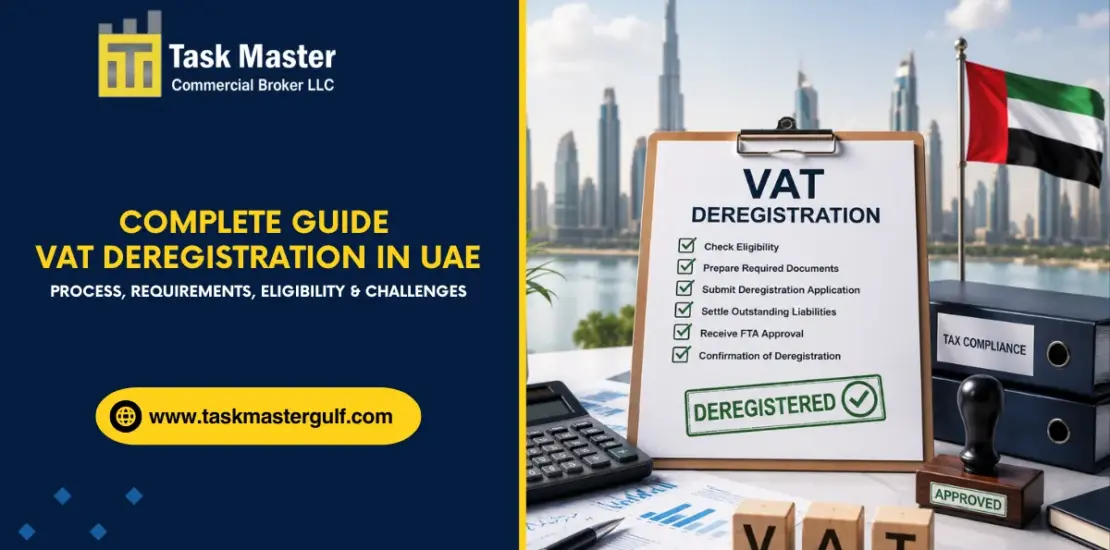
VAT deregistration in the UAE is the formal procedure of canceling a business’s Tax Registration Number with the Federal Tax Authority. This action is stringently time-sensitive: companies should make an application within 20 business days of becoming eligible; management fines will apply.
Registering for Value Added Tax is a primary milestone for expanding companies in the United Arab Emirates. However, business conditions change. Corporations close down, restructure, or experience shifts in their annual sales. When these modifications happen, you may have to cancel your Tax Registration Number with the Federal Tax Authority. This procedure is renowned as VAT deregistration UAE. Canceling your TRN is not as easy as clicking a button or closing your business doors. The FTA has stringent timelines, hefty penalty structures, and accurate paperwork rules that companies should follow.
For a seamless and hassle-free cancellation, working with an experienced corporate consultant can help streamline the process and ensure compliance.
Table of Contents
What is VAT Deregistration?

VAT deregistration is the official procedure of canceling your company’s VAT registration with the Federal Tax Authority. Once your application is examined and formally sanctioned, your TRN is deactivated.
From your official deregistration date onward –
- You can no longer charge or collect VAT on taxable supplies after the effective deregistration date.
- You can’t claim back any VAT paid on business expenditures.
- You are no longer needed to file routine, periodic VAT returns.
Important Warning – Don’t just prevent filing VAT returns if your business prevents trading. Keeping an inactive TRN without filing returns will lead to huge, compounding non-adherence fines from the FTA.
VAT Deregistration Eligibility UAE – When Must or Can You Deregister?
The FTA splits registration into two different kinds: compulsory and voluntary. Understanding which class your business fits into dictates your deadlines and legal duties.
1. Mandatory VAT Deregistration UAE –
Your business is lawfully forced to make an application for deregistration if you fulfill any of the following criteria –
- Cessation of Business – The company has fully stopped running, making taxable sales, and has no intention of restarting functions in the next 12 months. This is common during formal company liquidations.
- Falling Below the Floor – The business continues to run, but its taxable supplies over the last 12 months fell below the mandatory VAT registration threshold of AED 375,000.
The 20-Day Rule – For compulsory cases, you have to present your application to the FTA within 20 business days from the date the trigger event happened. Failure to apply within the required timeline may result in an administrative penalty of up to AED 10,000.
2. Voluntary VAT Deregistration UAE –
Voluntary deregistration is an alternative. You are qualified to make an application if –
- Your taxable supplies in the last 12 months fell below the mandatory registration threshold of AED 375,000 but remained above the voluntary registration threshold of AED 187,500.
- If you originally registered for VAT on a voluntary basis, you should wait at least 12 months from your initial registration date before you are permitted to approach a voluntary deregistration. There is no stringent 20-day deadline for voluntary applications.
The Step-by-Step VAT Deregistration Process in the UAE

The whole procedure is handled electronically through the FTA’s centralized EmaraTax portal.
1. Log in to EmaraTax – Access your profile through the official government portal utilizing your registered credentials or your incorporated UAE Pass app.
2. Initiate the Application – Handle your active dashboard, click on the VAT tab, find the actions dropdown menu, and click on De-register.
3. Complete the Form – The portal automatically populates your company’s main information. You have to choose your particular reason for deregistration from a dropdown list and enter the precise date the eligibility event happened.
4. Upload Required Documents – You should attach clear, official digital proof supporting your application. The particular documents are completely based on your reason for canceling.
5. Settle Liabilities and File the Final Return – Once the FTA reviews your initial application, they will modify your status to permit you to file a Final VAT return. This return should account for all transactions up to the effective deregistration date. You should pay off any overdue tax dues or administrative penalties instantly; otherwise, the deregistration request may be rejected or delayed.
6. Receive Confirmation – Once all balances are settled and the FTA completes its review, the FTA will change your position to De-registered and give you an official, downloadable VAT deregistration certificate, finished with a technical verification QR code.
Strict VAT Deregistration Requirements UAE
The main reason the FTA rejects or delays deregistration applications is missing or inappropriately formatted documentation. To sidestep delays, prepare the following concerns based on your scenario –
1. Core Financial Documents –
- Financial Turnover Declaration – A formal spreadsheet presenting month-by-month taxable sales, zero-rated supplies, and business costs from your initial registration date to the present. This should be printed on the corporation’s letterhead, signed, and stamped.
- Latest Financial Statements – Profit and Loss records, trial balances, or complete balance sheets.
- Bank Statements – Presenting current business activity or a zero balance for closing corporations.
2. Legal Documents –
- Official Trade License Cancellation Certificate – Given by your respective local Department of Economy and Tourism or Free Zone Authority.
- Company Liquidation Report/Board Resolution – Official legal documents proving that the shareholders voted to dissolve the company unit.
- Ministry of Human Resources and Emiratization Letter – Official confirmation presenting that all worker visas have been rejected and the labor files are closed.
Major Challenges and Pitfalls in VAT Deregistration
A number of business owners assume that canceling a tax account is a formality. In reality, it can transform into a complicated legal headache due to a number of primary functional difficulties.
1. The Trigger for Tax Audits – Presenting a deregistration application signals to the FTA that you are leaving the tax system. In certain cases, the FTA may conduct a risk-based review or tax audit of historical financial records during the deregistration process. If your historical bookkeeping contains discrepancies or compliance issues, you could face huge fines right at the exit door.
2. The Compounding Late Penalty – If you forget about the 20-business-day rule to make an application for a necessary deregistration, you may face an administrative penalty of AED 10,000 for failing to submit the deregistration application within the required timeline.
3. Clearing Pre-existing Penalties – The EmaraTax system blocks the finalization of deregistration if your account presents a single exceptional filing. You have to clear all historical tax debts and old late-filing fees first.
4. Disposing of Capital Assets – When you deregister, any remaining business inventory or capital assets on which you previously recovered input tax may be treated as a deemed supply. You might have to compute and pay output VAT on these products before exiting the system.
Conclusion
VAT deregistration in the UAE is a vital compliance task that necessitates careful financial reconciliation and adherence to timelines. Whether your business is going through a mandatory VAT deregistration UAE due to a closure, or a voluntary VAT deregistration in the UAE due to falling revenues, missing the FTA’s deadlines can result in steep administrative penalties.
Businesses need to make sure their books are in order, calculate any deemed supplies on remaining assets, and make sure all outstanding liabilities are paid off, to ensure a smooth transition out of the tax system. While it can be a complex process, working with professional VAT deregistration services UAE, such as Taskmaster Commercial Broker LLC, will ensure your cancellation is done efficiently, legally, and without any surprise financial hurdles.
Also Read
Frequently Asked Questions
When do I have to apply for mandatory VAT deregistration?
You need to send your application to the FTA within 20 business days from the date your business became eligible for deregistration (for example, the date your trade license was officially cancelled).
What happens if you miss the deadline to deregister for VAT?
If you fail to apply within the mandatory 20-business-day period, the FTA may impose an administrative penalty of AED 10,000.
What if I want to deregister from VAT but I still have outstanding tax penalties?
No, the FTA will not approve your application if there are any outstanding liabilities. Your TRN cannot be deactivated unless you have settled all pending tax dues and administrative fines.
How long should I keep my financial records after deregistration?
As per UAE Law, you need to store all tax invoices, accounting books, and financial records safely for at least 5 years after deregistration (or 15 years for real estate assets).
What does ‘deemed supplies’ mean in the process of deregistration?
Deemed supplies means any remaining stock of goods, or capital assets, in relation to which you have previously reclaimed input tax. You’ll need to work out and pay output VAT on these goods before you deregister.


